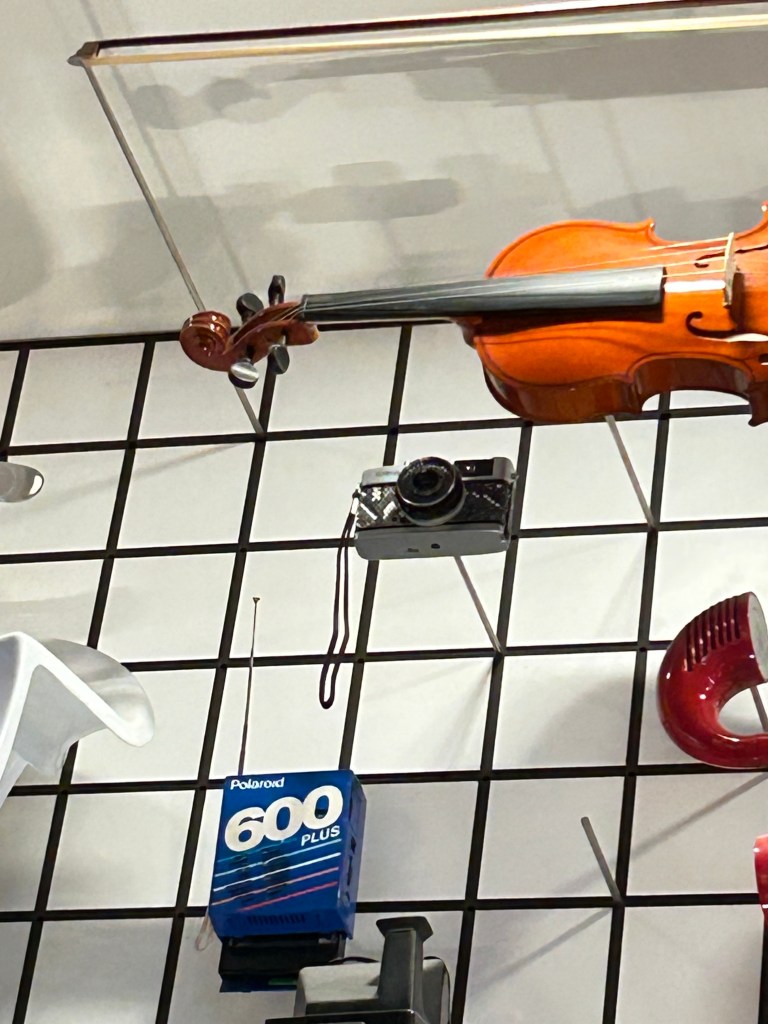
During my visit to The Design Museum in London, I focused on the analogue camera display within the permanent exhibition, Designer Maker User. Among the most influential objects on display is the Polaroid 600 camera, shown alongside its iconic instant film pack. Launched in the early 1980s by the Polaroid Corporation, this object represents a pivotal moment in the history of visual culture and industrial design, bridging the gap between traditional mechanical photography and the desire for immediate visual gratification.
The Polaroid 600 is an exemplary model of user-centered design. Built with a durable plastic housing, simple boxy silhouette, and a distinctive pop-up flash unit, the camera was designed for accessibility rather than technical complexity. Unlike traditional 35mm cameras of its era—which required manual film winding and darkroom processing—the Polaroid 600 integrated a chemical processing system directly inside the film pack. Users could capture an image and watch the photograph physically develop within minutes. The design prioritised physical interaction and simplicity: a single shutter button, a basic light/dark slider, and an ergonomic viewfinder made photography intuitive for non-professionals.
From a cultural perspective, the Polaroid 600 fundamentally changed how people interacted with images. It democraticized photography by making image production instant and personal. Long before the invention of digital displays or social media platforms, instant cameras introduced the concept of the “instant visual memory.” Photos were no longer confined to formal family albums; they became physical objects shared immediately among friends. This sense of tangible immediacy gave the Polaroid a unique aesthetic identity—characterised by square white borders and saturated color tones—that continues to influence modern digital photo filters today.
Examining the Polaroid 600 offers valuable insights for today’s photographic industry. As the market shifts toward digital speed and Artificial Intelligence (AI) automation, the physical Polaroid serves as a reminder of the core purpose of photography: storytelling and personal expression. While AI algorithms can generate or edit images instantly, they lack the physical authenticity and unpredictability of analogue film. The revival of instant photography among contemporary creatives highlights a growing demand for tactile, genuine visual experiences in an increasingly digital world.
In conclusion, the Polaroid 600 is much more than a vintage consumer electronic; it is a milestone in design history that transformed photography from a specialized craft into a dynamic social activity. Its inclusion in The Design Museum highlights its lasting legacy in visual communications, demonstrating that good design seamlessly combines technical innovation with human emotion.


Leave a Reply